

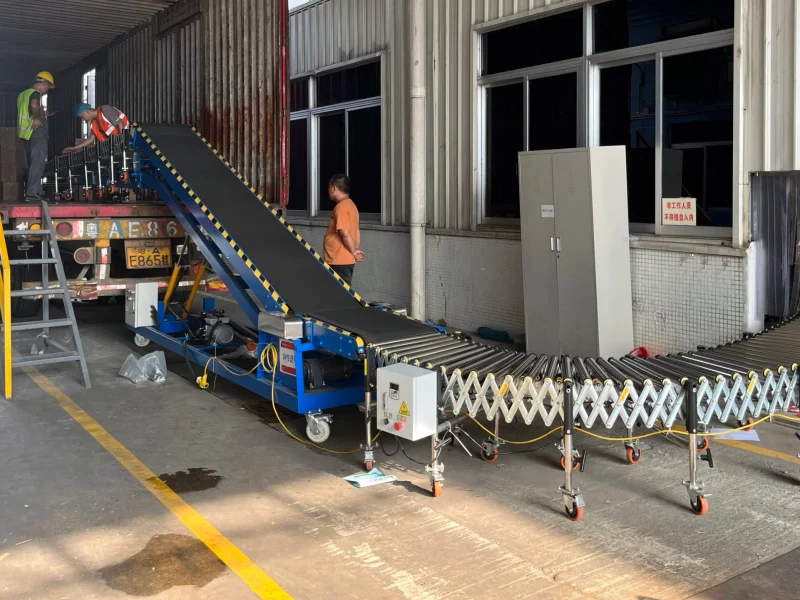
Flexible Roller Conveyor for Truck Loading and Unloading
In busy warehouses and distribution centers, truck loading and unloading can quickly become a bottleneck. Workers often have to manually carry cartons from trucks to storage areas or vice versa, which is time-consuming and physically demanding. To improve efficiency and reduce manual handling, many logistics facilities are adopting flexible roller conveyors.
A flexible roller conveyor for truck loading and unloading offers a simple yet highly effective solution for moving cartons, boxes, and parcels between trucks and warehouse operations. With its expandable structure and portable design, it provides both flexibility and efficiency for modern logistics environments.
What Is a Flexible Roller Conveyor?
A flexible roller conveyor is a type of expandable conveyor system that uses rollers to move goods along the conveyor path. The system features a scissor-like frame structure, allowing it to extend, retract, and even curve as needed.
Unlike fixed conveyors, flexible roller conveyors can be adjusted to different lengths and shapes, making them particularly suitable for loading docks and truck bays where space and operational conditions frequently change.
Most flexible roller conveyors are mounted on casters, allowing workers to easily reposition them between different loading docks or trucks.
Why Use Flexible Roller Conveyors for Truck Loading and Unloading?
Truck loading operations often require workers to move large volumes of cartons within limited time frames. Traditional manual handling not only slows down operations but can also increase the risk of worker fatigue and injury.
Flexible roller conveyors help solve these problems in several ways:
1. Improved Loading Efficiency
With a conveyor in place, cartons can simply be pushed or allowed to roll along the conveyor instead of being carried. This significantly reduces loading and unloading time, especially during peak warehouse operations.
2. Reduced Labor Intensity
Manual lifting and carrying can be physically demanding. Flexible roller conveyors minimize the need for workers to repeatedly lift cartons, helping to reduce physical strain and fatigue.
3. Adaptability to Different Truck Sizes
Because the conveyor can extend and retract, it can easily adjust to different truck or container lengths. This makes it a versatile solution for warehouses that handle multiple vehicle types.
4. Easy Mobility
Flexible roller conveyors are typically equipped with locking casters, allowing them to be moved between loading docks or storage areas quickly.
5. Cost-Effective Solution
Compared with automated conveyor systems or telescopic belt conveyors, flexible roller conveyors offer a lower investment cost while still providing significant improvements in efficiency.
Key Features of Flexible Roller Conveyors
Flexible roller conveyors are designed with practicality and durability in mind. Some of the most common features include:
- Expandable conveyor length to match different truck depths
- Curved configuration capability for complex layouts
- Adjustable height to align with truck floors or dock platforms
- Heavy-duty steel frame construction for industrial use
- Galvanized steel or PVC rollers for smooth material movement
- Lockable casters for easy mobility and stability
These features allow the conveyor to adapt to various loading environments without requiring permanent installation.
Typical Applications in Warehouse Operations
Flexible roller conveyors are widely used in logistics and distribution environments where trucks need to be loaded or unloaded frequently.
Common applications include:
- Warehouse truck loading and unloading
- Parcel and courier distribution centers
- E-commerce fulfillment facilities
- Packaging and sorting lines
- Retail distribution warehouses
In many facilities, flexible roller conveyors are also combined with other equipment, such as telescopic belt conveyors or powered conveyors, to create a more efficient loading system.
Typical Technical Specifications
Although specifications vary depending on manufacturer and model, most flexible roller conveyors fall within the following ranges:
| Parameter | Typical Range |
| Conveyor width | 400–1000 mm |
| Roller diameter | 38–60 mm |
| Roller pitch | 75–120 mm |
| Load capacity | 20–100 kg/m |
| Extended length | 4–10 m |
| Height adjustment | 700–1000 mm |
These specifications make flexible roller conveyors suitable for handling cartons, parcels, boxes, and other packaged goods.
Flexible Roller Conveyor vs Fixed Conveyor
One of the main advantages of flexible roller conveyors is their adaptability.
Fixed conveyors are ideal for continuous production lines where layouts rarely change. However, in truck loading areas where conditions are constantly shifting, flexible conveyors provide the mobility and adjustability needed for efficient operations.
Because they can be easily repositioned and stored when not in use, flexible roller conveyors are particularly valuable in facilities with multiple loading docks or seasonal fluctuations in shipping volume.
Choosing the Right Flexible Roller Conveyor
When selecting a flexible roller conveyor for truck loading and unloading, it is important to consider several factors:
- Load capacity requirements
- Conveyor width and length
- Roller material
- Warehouse layout
Frequency of truck loading operations
Choosing the right configuration ensures that the conveyor system can handle operational demands while maintaining efficiency and durability.
As warehouse operations continue to grow in scale and complexity, improving truck loading and unloading efficiency becomes increasingly important. A flexible roller conveyor provides a practical, cost-effective solution that reduces manual labor while speeding up the movement of cartons and parcels.
With its expandable design, portability, and ease of use, the flexible roller conveyor for truck loading and unloading has become an essential tool for modern logistics and distribution centers looking to streamline their operations and improve productivity.
Leave Me Your Requirement!